



October 01, 2026
A Bolder Vision
New President Philip Cavalier Charts Course for a Thriving Future
By Vicki Mayk
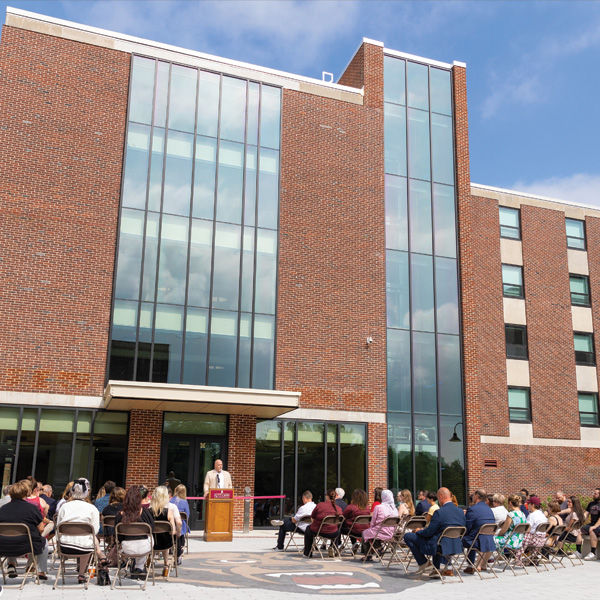
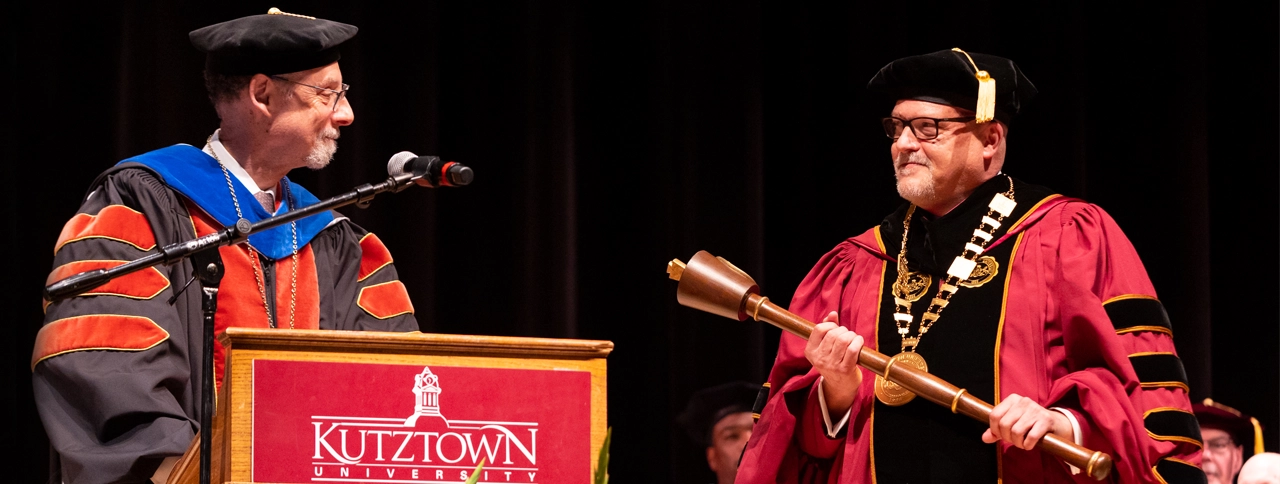
By the time Philip Cavalier was inaugurated as Kutztown University’s 13th president in April 2026, he was a man who needed no introduction.
That’s because, since arriving in July 2025, he prioritized getting to know students, faculty, legislators, alumni, donors and community members. He passed out doughnuts to students at campus crosswalks, joined them for meals in South Dining Hall, and practiced with the women’s lacrosse and basketball teams. There were trips to Reading and Allentown to meet with mayors and county officials, and visits to 19 high schools in Berks and Lehigh counties. He also met with legislators and donors both on and off campus.
“The reason to do this is to make sure we’re visible in the community,” Cavalier says, noting that such visibility can lead to community partnerships, donor support, and more students pursuing a KU education.
The university has proven to be the vibrant place he thought it was when he visited during the presidential search, Cavalier says. But after a year on the job, his focus is now on making KU the best it can be during a time when higher education faces unprecedented challenges like shrinking enrollments and reduced funding. In his inaugural address, he summed up his vision for KU in a single word: bold.
“I came to an institution that was solid in a lot of ways, but I don’t think of (my job) as just being a caretaker,” Cavalier says. “I think of it as really helping to push for a bolder vision of what this place can be, and already is, in a lot of ways.”
One of his goals is encouraging what he calls “a culture of innovation on campus” that challenges both faculty and administrators to propose new ideas and solutions to problems. “… There are really smart people on this campus and they need to feel like it’s safe to experiment and imagine some things that are pretty bold … At the end of the day, there’s no way that institutions of higher education can just continue in the same way. I also think there are opportunities that smart people can pursue to make the institution stronger.”
A Student-Centered Focus
While interviewing to become president, Cavalier was attracted to the university’s commitment to help students from many backgrounds to thrive. “It’s the best kind of undergraduate education and work that you can do,” he says. “My role is to ensure that we do as much as we can as a university to remove obstacles for students to thrive here. Sometimes that means re-thinking how we do student life… or how we do academic affairs. Sometimes that’s literally reminding people that how you do things should not be guided by your convenience.”
Removing obstacles will be necessary to achieve some of the priorities he has identified for strengthening students’ educational experience.
“In five years, every student who goes to Kutztown should have either studied abroad, had the opportunity to do undergraduate research with a faculty member, experienced an internship or some kind of service-learning course,” Cavalier says. “All of the data in higher education shows that those experiential, high-impact practices increase the likelihood of students persisting to graduation and have a meaningful impact on them.”
He rejects the notion that studying abroad is reserved for wealthier students. Philanthropic support can make such experiences accessible to all, and he is prioritizing fundraising to expand student opportunities. Citing a recent gift from a donor that supports study abroad, Cavalier says, “It will allow us to offer some scholarships for students who are unable to raise the full amount.”
As the university prepares to launch a capital campaign, raising funds to increase student scholarships and create an emergency fund for students will also be among his priorities.
Expanding Access
Being an institution that provides access to higher education has always been central to Kutztown’s mission. Expanding the definition of access is the key to the university’s continued stability and success, Cavalier says.
“Practically speaking, we’re already hitting the decline in the number of graduating high school seniors and that will continue,” he says, referencing what researchers have called an “enrollment cliff” – the result of sharply declining birth rates since 2007.
“We could have a conversation on campus and say, ‘That just means we need to double our market share.’ But I think that’s entirely unrealistic to say we’re going to sustain that for the next 40 years.” A better solution, he suggests, is to attract non-traditional students – many of them working adults – outside of the traditional 18- to 24-year-old college age group. He is introducing ways to make it easier for such students to enroll.
“Next year, we’re going to have several of the student support offices open until 7:30 p.m. on Monday night. That’s for the convenience of the kinds of students we need to bring into Kutztown, in addition to our 18- to 24-year-olds,” he says.
Cavalier also is exploring ways to offer KU classes – and, in some cases, the ability to earn a full degree in certain majors – at satellite locations. Plans are underway to offer classes in Reading at a space adjacent to the GoggleWorks Center for the Arts. And he’s met with the City of Allentown about a possible location in center city.
Such plans give new meaning to the word “access” by acknowledging that some people don’t have transportation to campus. They also reduce commuting costs or eliminate additional student loan debt to cover living away from home.
It is all part of what it means to be an access institution, Cavalier explains. “We need to be there because we are a very affordable option,” he says, adding that offering classes in Reading and Allentown has the potential to bring the cost of a KU degree within reach of more students who have earned two-year associates degrees. “The reality is that many of the students there, based on their academics and their eligibility to receive Pell grants, might be able to go through a year paying $1,500 or $2,000 total (out-of-pocket for college).”
Meeting Community Needs
Meeting regional needs will be key in identifying new programs and partnerships, Cavalier states. In his early outreach to legislators, mayors, schools, and local businesses, he’s gathered feedback about the programs needed in Berks and Lehigh counties. High school counselors say engineering and nursing degrees are in demand among students and regional economic development data affirms employment opportunities are high in those fields.
With that in mind, Cavalier asked the provost and faculty members in KU’s Physics Department to add bachelor's degree programs in engineering physics and engineering technology. These areas currently are offered as concentrations within the physics degree.
Other partnerships will bring new students to campus. For example, a recent agreement gives Berks County employees a tuition discount when enrolling. A dual enrollment program with Kutztown Area High School will allow students to take one KU class for free. “It’s a matter of deciding to forego a relatively small amount of revenue to create goodwill – and maybe to get a couple of students who previously weren’t interested in KU,” he says.
Cavalier emphasizes that community outreach needs to include promoting what the university already does to support its neighbors – such as the Communication Design program’s annual Design-A-Thon, which offers pro bono design work to local businesses and nonprofits. This includes his own involvement serving on Berks County’s 275th Anniversary Committee and the board of Experience Reading and Berks tourism organization. “Initiatives like these are going to bring attention to Kutztown as a legitimate partner in Reading and Lehigh County and I think it will lead to other opportunities that I couldn’t possibly anticipate now,” he says.
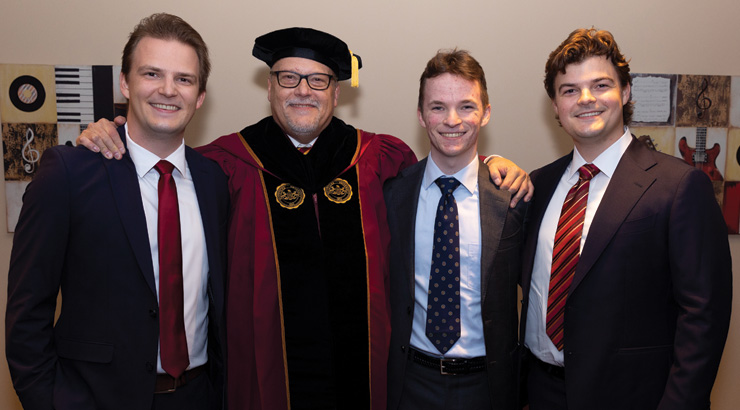
President Cavalier with his sons (from left) Toby, Elijah and Benjamin.