




October 01, 2026
Relics advance student research
Religious Folk Art and the Veneration of the Saints at the Pennsylvania German Cultural Heritage Center.
By Patrick Donmoyer ’09, M’25, director, Pennsylvania German Cultural Heritage Center
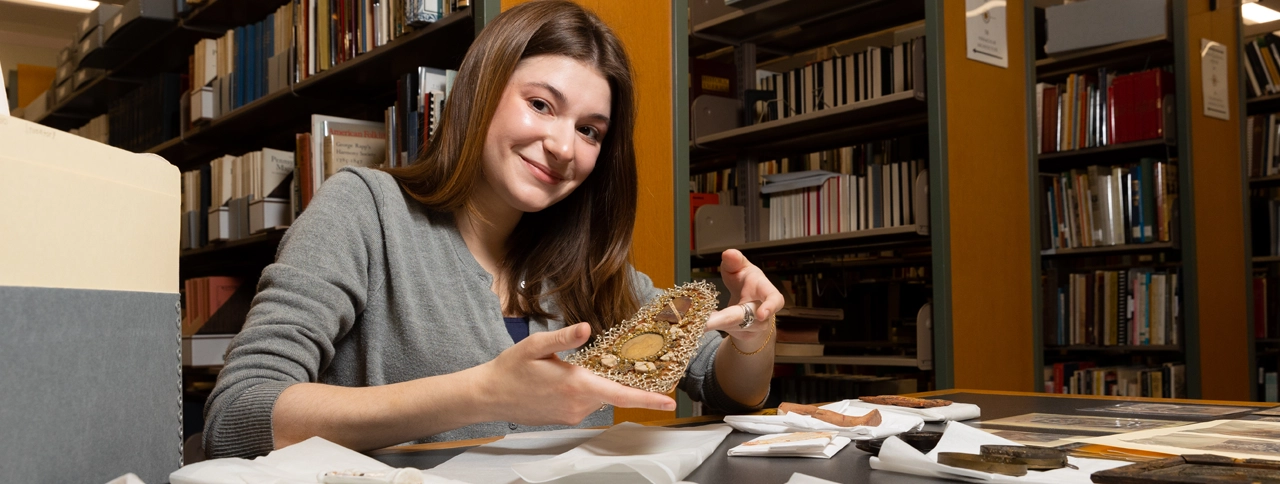
Julia Sweeney ’26 never imagined that her internship at KU’s Pennsylvania German Cultural Heritage Center would resonate so deeply with her Roman Catholic heritage.
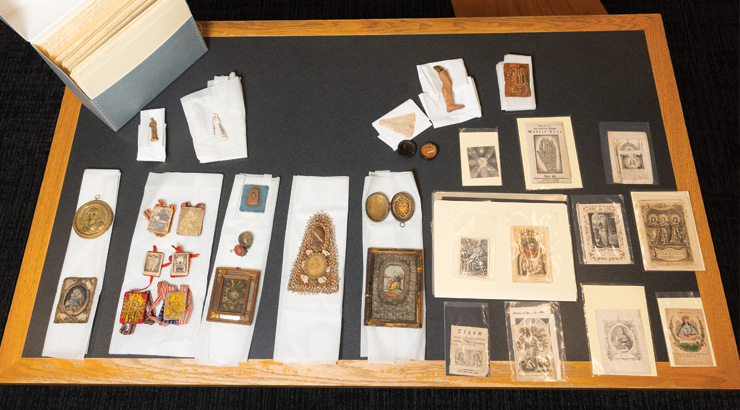
As an art history major with minors in studio art and chemistry, Sweeney approached the Heritage Center in the summer of 2025 seeking hands-on experiential learning opportunities to support her burgeoning interest in the museum profession. When she was invited to document and catalogue a collection of rare late 18th and early 19th century Roman Catholic reliquaries — devotional objects consecrated by contact with historical remains of Catholic saints — Sweeney enthusiastically agreed. That launched her year-long research project exploring these exquisite expressions of sacred art. Sweeney’s research culminated in the development of a thematic cultural exhibition in the Heritage Center Library Embodying the Sacred: Religious Folk Art and the Veneration of the Saints, that opened this month.
Uniquely equipped through her Catholic upbringing to identify the saints associated with these artifacts, Sweeney meticulously worked to document, preserve, and ethically interpret the reliquaries. Many of the items purport to contain minute fragments of the bones of martyrs venerated by the Catholic Church, or to have been in contact with the saints’ remains, personal objects, or shrines devoted to their memory. Sweeney’s research was conducted in cooperation with the regional Catholic diocese to ensure that the project was guided by best-practices in the handling and care of the reliquaries. In addition, professional museum standards at the Heritage Center were followed, requiring consultation with source communities represented in cultural exhibitions.
These intricate and artistically embellished religious objects had been recently discovered in the collection of the late Dr. Don Yoder (1921-2015), who donated his extensive research archive to the Heritage Center. Co-founder of the Kutztown Folk Festival, foremost scholar of Pennsylvania German Studies, and initiator of the American Folklife Studies movement, Yoder pioneered the study of folk religion through comparative transatlantic research while chair of the department of Religious Thought at the University of Pennsylvania. Colleagues in Switzerland sent the reliquaries to Yoder after they were deaccessioned from the now defunct Schweizerisches Museum für Volkskunde (Swiss Museum for Folk Culture), which eventually merged with the Museum der Kulturen (Museum of Cultures) in Basel.
Sweeney’s research suggests that while the condition and unverifiable authenticity of these reliquaries does not hamper their interpretive value from a folk-cultural perspective, it certainly undermines their significance within the framework of institutional Catholicism. The objects are protected within enclosures crafted from glass, metal, horn, and wood. Intricately embellished with delicate coils of decorative paper, gilded flourishes of wire, or a latticework of beads, these reliquaries are small enough to have been carried in one’s personal effects for devotional purposes. Many show decades of wear from use and appreciation. Wax seals, originally applied by church authorities to verify the authenticity of the relics, are worn, compromised, or missing altogether, rendering them uncertain from an institutional religious standpoint, but still personally and culturally significant.
This was precisely what drew Yoder’s interest, who celebrated the common everyday experience of religious practices and customs on the folk-cultural level. Yoder observed that although the majority of Pennsylvania Germans are officially protestants, with a Roman Catholic minority of just under 1%, the culture’s traditions, folk beliefs, and customs are still deeply rooted in liturgical Catholicism of the Middle Ages. Accordingly, Sweeney’s exhibition highlights not only the reliquaries, but also comparative aspects of Pennsylvania folk culture that parallel these official Catholic religious expressions. As both an art historian and a Catholic, Sweeney felt compelled to examine the nuances of how art functions in the lives of religious people, offering that the experience of working with the reliquaries was both a formative and highly meaningful experience.
Last May, Sweeney graduated from KU with honors and traveled abroad to study art conservation through the Amelia International Conservation Studies program, part of the Art Restoration and Conservation International Field School in Amelia, Italy. There she focused on conservation of altarpieces, paintings, and frescoes. Sweeny returned to the Heritage Center in July and August through a co-op internship to complete her work on the exhibition while building her professional skill set through work experiences in safe handling and care for delicate artifacts and archival materials.
Sweeny is one of 25 students that the Heritage Center hosted for hands-on experiential learning opportunities in the 2025-2026 academic year. As Museum Associates, students gain formative professional experiences assisting the Heritage Center staff with cataloging, digitizing, and interpreting cultural collections and works of art through archival preservation projects, exhibitions, and online galleries. Students receive specialized training in proper handling, processing, and care for cultural collections in keeping with best practices for museums. As part of the onboarding process for new Museum Associates, students explore the Heritage Center galleries and collections, and build upon their sense of curiosity to develop unique projects that meet their academic requirements and nurture their personal interests.
Reflecting on her experiences at the Heritage Center, Sweeny offers: “My favorite thing about working here is definitely the students’ ability to choose projects that interest them and are connected to them in some personal way.”
Sweeney’s research highlights the Heritage Center’s emphasis on building cross-cultural understanding through the exploration of regionally specific traditions, arts, and folkways. This inspires students’ curiosity for one’s own cultural experiences, and fosters empathy and appreciation for those of others.
Over the past 14 years serving as director of the Heritage Center, I’ve witnessed firsthand how a program that once appealed primarily to local students with Pennsylvania German roots has blossomed into an engaging and welcoming experiential learning community for students of all backgrounds. One does not need to be Pennsylvania German to find meaningful ways to relate to the arts, traditions, and folkways of the region, while developing professional skillsets and experiences in a museum setting.
In fact, outside perspectives offer fresh new ways to explore and engage with the arts and unique culture of the region. Sweeney, whose roots are Italian and Irish, brings unique insights to the Heritage Center’s cultural collections, and will carry forward her experiences with Pennsylvania German material culture as she prepares for graduate studies in art conservation.
To learn more about Julia Sweeney’s work, visit the new exhibition Embodying the Sacred: Religious Folk Art and the Veneration of the Saints in the Heritage Center Library gallery, or visit online at www.pagerman.org/embodying-the-sacred.