






PAST AWARDS - 2024
Below are abstracts of KU BEARS grant awards from 2024. Click on the titles to read each abstract.
-
The influence of a periodical cicada emergence on Veery body condition
Todd Underwood
College of Liberal Arts and Sciences | Biological Sciences
Abbee Fries
Major: Biology: Organismal/Ecology
Overview:
Periodical Cicadas (Magicicada species) spend 13 or 17 years as nymphs underground where they feed on the roots of trees. Millions of adult cicadas emerge synchronously in forested areas in spring to saturate predators and breed. Cicadas provide an abundant food source for many birds and may lead to bird population increases in future years. However, little is known about how periodical cicadas influence bird body condition and fat levels during an emergence year. In this study, we compared body condition (mass/wing length) and fat levels of Veeries (Catharus fuscescens), a forest songbird, in a periodical cicada emergence year (2021) to the adjacent years without this potential superabundant food source. We found that Veery age did not influence body condition or fat level, but body condition differed significantly by sex, so we compared trends separately for males and females. For both males and females body condition and fat levels were not significantly different in the cicada emergence year compared to adjacent years. Surprisingly, there was no evidence that cicada availability led to improved body condition or fat stores. Because Veeries are ground foragers, we suspect that cicadas were only available to them as a food source for a short period of time as nymphs. Once the cicadas emerge as adults, they fly into the tree canopy to breed and are no longer available to Veeries as prey. Future research should examine other bird species with different foraging niches.
-
Three Thrones Geophysical Investigation
Laura Sherrod
College of Liberal Arts and Sciences | Physical Sciences
Sierra Smart
Major: Geology
Overview:
Sierra Smart was a research assistant / collaborator for the Three Thrones Geophysical Project this summer. She enhanced her summer experience by also assisting in the Green Cabin Archaeological Site Geophysical Investigation. These projects required her to learn the set up and calibration of the geophysical equipment, determine the best survey grid layout for several survey blocks in multiple locations, assist with the proper use of the equipment, learn to process and analyze the data collected, construct a final report for a site contact, and present the findings to a historical society. The final two aspects of this are yet to be completed and will be wrapped up during the Fall 2024 semester. Sierra spent three full days running geophysical surveys at the Three Thrones property with a field crew of myself and one other student. All field workers were experienced in conducting geophysical surveys. Two geophysical methods were utilized at the site: ground penetrating radar (GPR) and 3 magnetometers. With the team of three experienced individuals, we were able to complete the entire area described in the original proposal for the work in a shorter time frame. Sierra and I met numerous times to process, analyze, and synthesize the data collected into a field report to deliver to the site contacts. We sat side by side working on the data we collected at the Three Thrones field site to process the data necessary to produce a final report and presentation for our site contacts.
-
Pollination Biology of Four Milkweed Species
Christopher Sacchi
College of Liberal Arts and Sciences | Biological Sciences
Caitlyn Polter
Major: Environmental Science
Overview:
There are several species of milkweeds native to Pennsylvania that can be found growing in natural sites in the Kutztown area, and which are recommended for inclusion in gardens or habitat restoration due to their attractiveness to pollinating insects. Two common milkweed species in Pennsylvania are common milkweed, Asclepias syriaca, and swamp milkweed, Asclepias incarnata. Insects known to visit and to pollinate milkweed flowers include native bumblebees, honeybees, flies, wasps, butterflies, and certain types of moths. Two tropical milkweed species, tropical milkweed, Asclepias curassavica, and Caribbean milkweed, Asclepias nivea, were both previously studied in nature in Jamaica. In this study we found that there were dramatic differences in plant traits of temperate and tropical milkweeds such as flower abundance and size, with temperate milkweed species producing more flowers per inflorescence than the tropical milkweeds. When tropical milkweeds were grown near temperate milkweeds, pollinator behavior was studied at the same location. Temperate milkweed flowers were visited more frequently than flowers of tropical species with bees being the most common visitors to temperate and wasps the most common visitors to tropical species. Insect visitors to milkweed flowers carried pollen-bearing structures called pollinia with bees on temperate species carrying the most pollinia and wasps on tropical milkweeds carrying the most pollinia. In conclusion, natural differences in traits of temperate and tropical species of milkweed lead to differences in their attractiveness to pollinators and eventually in their fruit and seed production when grown in a temperate environment.
-
The Use of Makerspaces in k-12 Schools and by Counselors
Roseanne Perkins
College of Education | Elementary, Middle Level, Library & Technologies Education
Molly Kutz
Major: Library Science
Overview:
Makerspaces are collaborative sites for hands-on, iterative, and interdisciplinary explorations. While not all K-12 schools have dedicated makerspaces, any teacher of any subject can be empowered to integrate making into their classroom practice. Our goal this summer was to collect data to help us better understand current makerspace initiatives in K-12 schools: What tools do most schools have? Which teachers are most involved? How prepared do teachers feel to use maker approaches in their classrooms? We developed and refined a survey using cognitive interviews and then distributed it to K-12 teachers, librarians, and other education professionals. Using the data from the survey, we developed a budget for a pilot mobile makerspace that we will be introducing to classrooms next year. We hope that our continuing research will help us to be able to better prepare teacher candidates to use maker activities, and to encourage veteran teachers to integrate makerspaces into their existing practices.
-
Expanding and refining QuEChERS/LC-MSMS method for pesticide screening of notorious fruit
Julie Palkendo
College of Liberal Arts and Sciences | Physical Sciences
Kerrigan Ciocari
Major: Environmental Science: Chemistry
Overview:
A liquid chromatography tandem mass spectrometry (LC-MSMS) method using multiple reaction monitoring (MRM) was expanded from 10 to 21 pesticide compounds, each of which have been frequently detected in notoriously “dirty” fruits and vegetables. The chromatographic separation of compounds was optimized to occur in under 8 minutes. Blueberries, grapes, strawberries, cherries, kale, spinach, green peppers, strawberries, peaches, pears, and apples were purchased from local supermarkets in both organic and non-organic varieties. Samples were blended, immediately extracted using the original QuEChERS protocol, and analyzed with the expanded LC-MSMS method. Detection limits for the 21 pesticides were at or below 2 parts per billion (ppb). Organic samples were used to obtain spike recovery data with percentages typically ranging between 70-110%. On average 3-4 pesticides were detected in the fruits and vegetables, and in most produce, at least one of the newly added pesticides was detected.
-
Energetic Rhetorics in Lithium Extraction
Megan O’Byrne
College of Visual and Performing Arts | Communication Studies
Amanda Celentano
Major: Communication Studies
Overview:
In response to the climate devastation wrought by oil and gas extraction and the burning of fossil fuels in personal/passenger vehicles, there is a push to become more carbon neutral by focusing on electric vehicles (EVs) as a primary form of travel. If the U.S. were able to switch to EVs by 2050, Lee and Northey (2023) of Scientific American argue the lithium needed to power those batteries would be required at a rate three times higher than total world production. The Guardian climate justice reporter Lakhani (2023) further argues increasing lithium extraction and production would also cause “needless water shortages, Indigenous land grabs, and ecosystem destruction.” Lithium extraction practices, if taken in a heavy-handed manner, are likely to have the same detrimental environmental impacts as fossil fuel extraction (Budryk, 2023).
In this paper we examine the energy communication surrounding the need for finding and producing lithium at a scale that can service the entire American personal car fleet. That conversation necessitates an understanding of energy communication, the lithium production and use process, and a look at the ways in which the U.S. government is working to make lithium fueled EVs more available to all. We argue that the energy communication around the future of lithium-ion fueled vehicles is presented as a false dilemma that greenwashes lithium as a renewable resource. That false dilemma sounds something like: Either we mine American lithium, become energy independent, and provide for ourselves OR in utilizing lithium from other nations we lose out on economic growth, become weaker as a nation, and fall behind in technological supremacy. In presenting this false dilemma, many additional fuel options and future technologies are ignored.
A note on photos: There are no photos to provide at this time as the summer was spent reading and writing behind a computer screen, but this research has been selected for poster presentation at the Pennsylvania Communication Association in late September. I would love to submit photos after that time documenting the research presentation in action. The student is listed as a co-author on the research and will lead the poster development and design process.
-
Social Identity and Industrialization in Eastern Pennsylvania
Khori Newlander
College of Liberal Arts and Sciences | Anthropology/Sociology
Amarah Karlick
Major: Anthropology
Overview:
The rise of American industry during the late-eighteenth and nineteenth centuries dramatically transformed the United States. Researchers who study early industrial communities wish to understand how physical, economic, demographic, and social factors intersected in the unfolding of industrialization. Archaeology is particularly well placed to provide relevant insight because it can trace trajectories of cultural change over extended periods of time. Archaeology can also recover material evidence of the countless men and women who, though lost to the history books, helped America become an industrial and economic power. In this study, Amarah Karlick and I examined the changes wrought by industrialization through the archaeological study of Joanna Furnace, a nineteenth-century ironworks in southeast Pennsylvania. Our analysis focused especially on a gun recovered from the ironmaster’s house. Our study provided an opportunity to develop strategies for safely curating and analyzing potentially dangerous artifacts, while also yielding insight into the unfolding of industrialization in eastern Pennsylvania during the late-eighteenth and nineteenth centuries.
-
Habitat Preference Maps of Mammal Species at Hawk Mountain Sanctuary
Andrew Mashintonio
College of Liberal Arts and Sciences | Biological Sciences
Morgan Herb
Major: Environmental Science: Biology
Overview:
Wilderness is increasingly being affected by human activities to the point where there are very few unaltered natural areas left. Thus, it is very important to understand the impact that humans have on wildlife, even in areas that are protected. Utilizing the outputs of occupancy models of different mammals across Hawk Mountain Sanctuary, we generated habitat preference maps that display the areas of the mountain that are most preferred by eight mammal species. Each map was unique and leaned towards the areas indicated as being preferred by the occupancy model, such as roads, trails, streams, or elevation. These maps will serve as a visual guide for conservation efforts of species of concern at Hawk Mountain Sanctuary.
-
A Study of Goldenrod Ball Galls & Mugwort Galls
Carol Mapes
College of Liberal Arts and Sciences | Biological Sciences
Zach Wink
Major: Secondary Education
Overview:
Study of Developing Goldenrod Ball Galls and their Inhabitants and a Novel Beetle-Induced Gall
Carol C. Mapes
College of Liberal Arts and Sciences | Biological Sciences
Zach Wink
Biology, Organismal Biology & Ecology and Environmental Science: Regenerative Agriculture
Insect galls are plant growths of distinctive morphologies caused by many different species of insects. This project included research on the goldenrod ball gall as well as research on galls formed by a previously unstudied beetle in North America. We identified and preserved goldenrod ball gall inhabitants from over 200 overwintered goldenrod galls that we classified into different size categories. Additionally, we measured developing goldenrod ball galls and tracked flowering status of the host plants in the field as part of the Continental Gall Size Project, a larger study involving many researchers across North America. We also studied novel galls formed by a beetle and conducted research to determine the range of this gall-inducing beetle in North America. We reared beetles from the galls to see if there is a correlation between gall size and the sizes and identities of the inhabitants that we reared. We also studied the internal anatomy of the galls using microscopy, including the KU Scanning Electron Microscope.
-
Towards Equity: Exploring Inclusive Critique in Art & Design Pedagogy
Dannelle MacIlwraith
College of Visual and Performing Arts | Art & Design
Melissa Laubach
Major: Communication Design
Overview:
KU Bear's grant helped research different critique methods and explore how traditional critique practices can be more inclusive. Over the summer, this grant helped me to analyze data, research inclusive design principles and data visualization methods, and develop infographics. Learning to create compelling infographics was an essential aspect of the project, which helped to understand how to translate data into clear and accessible visual formats. The research gave further insight into ways to rethink traditional critique methods to support students' needs better and improve feedback processes. Finally, having a student perspective on the ongoing discussion about developing more inclusive critique practices in the classroom was beautiful.
-
The Creation of a Videogame and Digital Literature Preservation Space at Kutztown University
Sandra Leonard
College of Liberal Arts and Sciences | English
Hannah Katein
Major: Game Development
Kody Knight
Major: Game Development
Overview:
Books, film, and music all have robust archival support in libraries and archives, making it possible for researchers and the public to access significant literary and artistic works from the past. Videogames are a growing medium of aesthetic and literary expression and are also worth preserving. However, videogames and digital literature largely lack archival support within library systems, including the library at our own university. Since many videogames can only be played on specific consoles and PC systems that can become out of date and difficult to find, it is necessary to for archivists to research ways that videogames can be preserved and playable in order that they can be appreciated for years to come.
The goal of this project has been to research to design and build a videogame preservation space in Kutztown University Library. This has involved researching other videogame archives that are being built in university archives across the country, researching historically and aesthetically significant videogames and digital literature, drawing up a detailed plan for purchasing and installing equipment and other material holdings, researching inclusive access strategies, and installing a preliminary exhibition space in the library.
-
Declining Birth Rates, the Welfare State, and Immigration Policy in Western Europe
Steve Lem
College of Liberal Arts and Sciences | Philosophy & Government
Sarah Snow
Major: Political Science
Overview:
Declining birth rates, a growing senior population, and other demographic shifts have led to the crisis of the European welfare state, where demand for services is outstripping supply. One strategy to offset this trend is to increase immigrant labor to replace these gaps in the workforce, although immigration policy is politically divisive. In this project, we argue that the socio-political coalitions formed by employment insiders and outsiders (Rueda 2005; Schwander 2023) drive political party positions on employment, the welfares state, and immigration. These positions, in turn, affect the immigration policies governments ultimately adopt. We analyze our model using data from the Comparative Welfare Entitlement Dataset and DEMIG-QuantMig Migration Policy database. We find that while insider-outsider politics matter, the effect is mitigated by the type of welfare policies already in place (i.e., welfare state typology).
-
Vita of Cardinal Ludovico Ludovisi Indexing Project
Pierette Kulpa
College of Visual and Performing Arts | Art & Design
Julia Sweeney
Major: Art History
Overview:
In 1632, Cardinal Ludovico Ludovisi died suddenly at the age of just thirty-seven from complications related to gout. Ludovico came from a storied family and was made cardinal by his uncle, Pope Gregory XV (r. 1621-1623), who had ruled as pope of one of the era’s shortest pontificates. Cardinal Ludovisi’s secretary and biographer, Lucantonio Giunti (d. 1661), penned an Italian language biography of his employer in the decades after his death that acted to remediate the cardinal’s reputation, qualifying the cardinal as a prudent, pious, and deft man who donated a huge portion of his immense wealth to charity. La Vita del Cardinal Ludovico Ludovisi Arcivescovo di Bologna (The Life of Cardinal Ludovico Ludovisi Archbishop of Bologna), the official title of the cardinal’s biography, was never transformed into a print publication and exists in just four hand-written manuscript copies in four different European collections.
This KU BEARS grant proposal saw Julia Sweeney, an Art History Major and Chemistry Minor, work on indexing a master copy of the cardinal’s Vita from a transcribed, type-written text, and researching the hundreds of people that feature within it. Julia mined the transcribed copy of the text for proper nouns (people, places, and artistic things, like buildings or works of art) and input them into a spreadsheet that will eventually become the basis for the index of a translated copy of the Vita. In order to better understand the people she researched, Julia occasionally consulted the original hand-written document for clarification (available in the form of high quality scans), dealt with Latin (which appears occasionally in the Vita), and became a sleuth on the many, often cryptic, acronyms, non-standardized spellings, and foreign titles that were used in the seventeenth century. Julia’s contribution to a better understanding of the Ludovisi pontificate and the life of one of the family’s most eminent cardinal’s is highly significant for historians, art and architectural historians, and enthusiasts of early modern Italy alike!
-
Understanding the Role of Family in Emergency Psychiatric Care for Individuals with Dementia
Christopher Harris
College of Liberal Arts and Sciences | Social Work
Karleigh Patton
Major: Communication Design
Overview:
The purpose of this study is to investigate the challenges, obstacles, and lived experiences faced by families in managing acute mental health crises for a loved one diagnosed with dementia and living in a Pennsylvania skilled nursing facility. This study will employ a grounded theory methodology to explore the lived experiences of family members who sought psychiatric care for their loved one in the past 12 months. Utilizing a family-in-environment (FIE) perspective, this research focuses on understanding the challenges family members encounter while trying to access mental health care for their loved ones within the mental health system and the role they played in this process.
-
Impact of a Campus Visit on Two Diverse Middle Level Student Populations
Carol Haney-Watson
College of Education | Elementary, Middle Level, Library & Technologies Education
Cara Kennedy &
Major: Elementary Education (4-8)
Shingyin Kha
Major: Elementary Education (4-8)
Overview:
We know that various student populations are more or less likely to attend institutions of higher education after high school. We also know that many factors influence how likely a student is to pursue higher education after high school.
Ozyyonum (2017) identified these factors as gender, socio-economic status, parent influence, and peer/school influence. Among low-income students specifically and historically, the primary factors in determining if students attended higher education are rigorous HS courses, high expectations of all students, and quality counseling and information (King, 1996). These services are less likely to be available to lower income students. Finally, America (2022) found that the top five reasons students don’t want to attend college are as follows: no one in their family has gone before, they think college will be too hard, they don’t know how to choose the right college, they’re worried they won’t fit in, and they’re not sure they can afford the cost. Given these issues, the guiding questions driving this investigation:
What are the effects of an organized visit to a university campus on middle level students’ attitudes toward higher education as an option? How do these effects compare between a rural and urban student population?
The two participating schools are classified as rural and urban student populations. Electronic surveys to be distributed before and after were developed. At this point in our process, data from the rural student population has been collected and initially analyzed. Data collection at the urban school is planned for fall 2024.
-
The Double Marriage: A Scholarly Edition
Jennifer Forsyth
College of Liberal Arts and Sciences | English
Jake Hensinger
Major: English
Overview:
My project, which is currently in the developmental stage, is to prepare a scholarly digital edition of The Double Marriage, a Renaissance play written by John Fletcher and Philip Massinger, for the Digital Renaissance Editions (DRE) website. The Double Marriage is a Jacobean tragedy dating back to around 1620; no full modern edition currently exists for it, much less an open-access edition appropriate for use by undergraduates and more advanced scholars alike. The DRE site is renowned for providing high-quality digital texts.
A digital edition typically encompasses an old-spelling diplomatic transcription that faithfully preserves the text as originally written or published; a modern-spelling text that presents the text of the play utilizing standardized and modernized spelling and punctuation; basic, brief footnotes for the modern-spelling text that explain archaic or obscure vocabulary or phrasing; advanced footnotes expanding on such issues as connections with or differences from other, similar Renaissance plays, relevant historical allusions, or connections with similar plays; a general introduction that comments upon the play’s significant characters, themes, and literary significance; a textual introduction explaining the text’s provenance; a performance-focused introduction documenting the play’s known performance history; and supplemental materials such as textual sources or analogues.
-
Cataloguing and Archiving Records of Pennsylvania German Life
William Donner
College of Liberal Arts and Sciences | Anthropology/Sociology
Alana Rohrbach
Major: Anthropology
Overview:
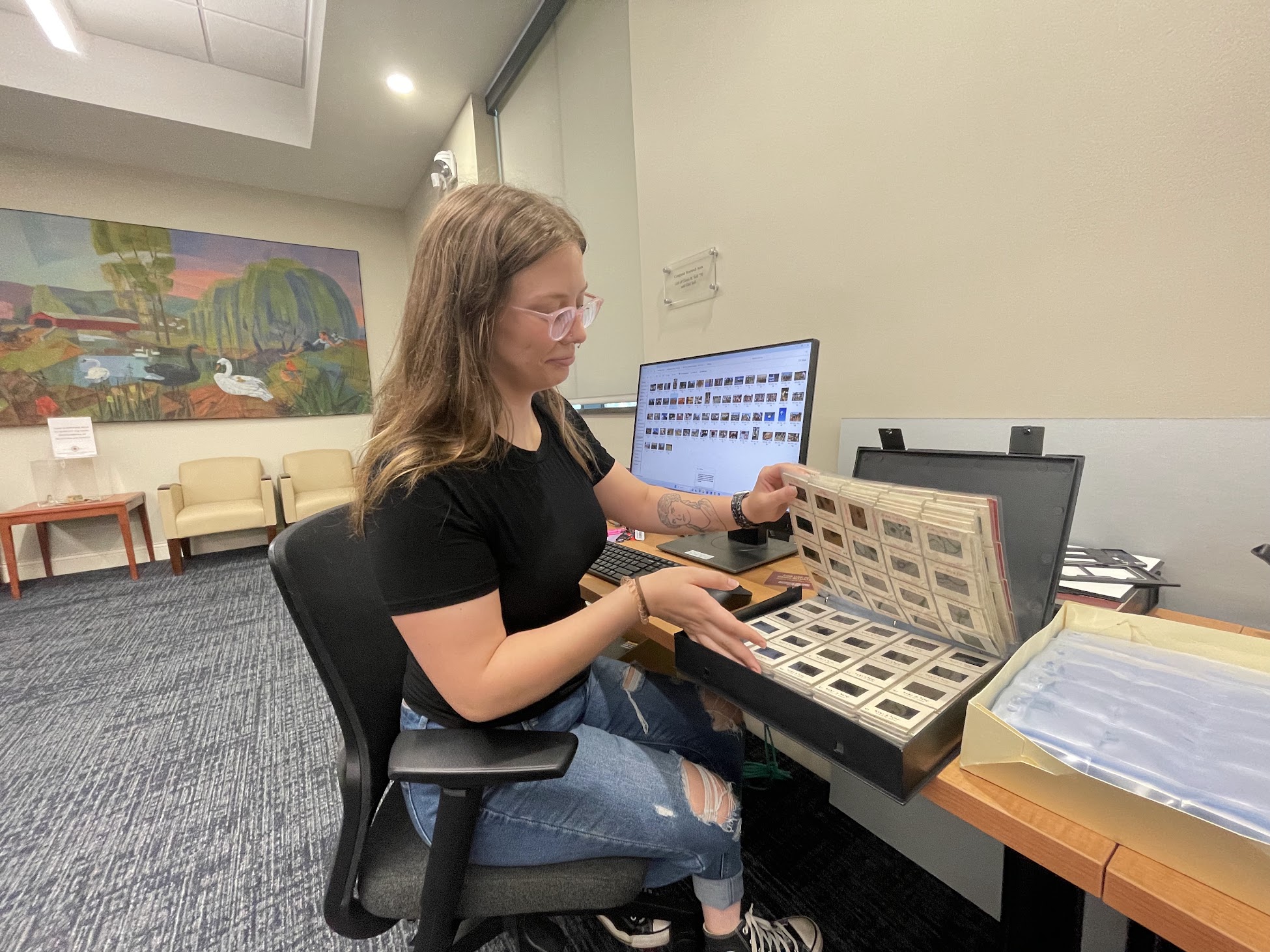
Alana Rohrbach worked on scanning and cataloguing slides of the Kutztown Folk Festival in the 1950s and 1960s. She worked on slides from the Bill Walter collection and the Richard Hoffman collections. The Kutztown Folk Festival, first held in 1950, was the first organized folklife festival in the country and became a model for many other folklife festivals including the one of the Smithsonian on the National Mall in Washington. The slides provide an insight into the festival’s early days and also its national importance. Bill Walter took pictures of NBC commentator, Arlene Francis interviewing Festival Director Alfred Shoemaker at the festival in the 1950s. Richard Hoffman was a Pennsylvania German modernist artist who moved from painting to photography and has pictures of the festival in the 1950s and 1960s. The slides show events at the festival including butchering, dancing, children playing, candle-making, food preparation, craft exhibitions, farm demonstrations, cooking demonstrations, a Fourth of July Parade down Main Street in Kutztown, re-enactments of a traditional funeral, a traditional marriage, the hanging of Susanna Cox, and other events. Some of these events are still presented, although in different ways and many of them are no longer performed.
Alana learned basic archiving skills including scanning and cataloguing. She also attended a seminar run by BePress (Elsevier) about uploading slides to their archival websites that are part of Rohrbach Library’s Research Commons:
See Pennsylvania German Dutch | Kutztown University Research | Research Commons at Kutztown University
Working at the Heritage Center, she also got to interact with other people involved in museum work, archival organization, heritage, and Pennsylvania German life and culture.
-
Atmospheric Particulate Trends by Pennsylvania County, 1980-2020
Michael Davis
College of Liberal Arts and Sciences | Geography
Katharine Lovelidge
Major: Geography
Overview:
Pennsylvania is prone to poor air quality due to primarily to its geography. Being the keystone of America, Pennsylvania roadways observe a high amount of traffic and is vital to logistics of goods moving throughout the eastern United States. Industrial hubs for manufacturing exist in Philadelphia and Pittsburgh, resulting in greater emission rates. The ridges and valleys of the Appalachian Mountains also contribute to inversion layers that can result in poor air quality.
This study focuses on the air quality of the two major urban cores in Pennsylvania (Pittsburgh and Philadelphia) and their surrounding counties. Examination of the percentage of days in which major pollutants (carbon monoxide (CO), ozone (O3), nitrous dioxide (NO2), and particulate matter (PM 2.5) contribute to air quality index (AQI) values. AQI is produced by the Environmental Protection Agency and is based upon the main pollutant each day for the period between 2000-2019. This study tests the difference between the southwestern (Pittsburgh core) and southeastern (Philadelphia core) counties of Pennsylvania and how the averages in the percentages of days in urban and suburban areas compare. Additionally, population change is tested in relevance to the county’s averages in percentages of main pollutant days, and population change, and urban/rural classification are used to identify statistical significance in the percent change of percentage days each pollutant is considered the main pollutant. Results reveal statistical differences in urban and rural areas based on their geographical location, and statistical differences in averages based on urban/rural classification.
-
Exploring the Experience of Long-Term Incurable Cancer for Patients and Families
Emily Cripe
College of Visual and Performing Arts | Communication Studies
Grace Levy
Major: Communication Studies
Overview:
With advances in treatment options, increasingly cancer patients are extending their lifespans, meaning that many patients with incurable diagnoses live for long periods of time (5-15 years or more) with their disease. The experience of long term, treatable but incurable cancer is under-researched, both in the field of communication and more broadly. Further, most research about cancer experiences focuses on the patient themselves or perhaps their primary caregiver. There is very little research on the effects of cancer on other family members or the family unit as a whole. This study explores the experiences of long-term incurable cancer patients and their families through in-depth qualitative interviews. These interviews explore the impacts of long-term incurable cancer on the lives, communication, and relationships of patients and their families. The study’s findings have the potential to improve both understanding of these experiences and care for patients with these diagnoses.
-
Identifying Proteins that Interact with Ctb9
Cristina Cummings
College of Liberal Arts and Sciences | Biological Sciences
Therese Coleman
Major: Biology: Molecular/Micro/Cell
Overview:
Ctb9 was originally identified in a screen for proteins that interact with Cul3, a protein that is used to control cell division and other processes by targeting specific proteins for destruction. Although Ctb9 was found to assist Cul3 in identifying target proteins, it likely has additional biological functions in the cell. Therefore, we performed a yeast two-hybrid screen to identify Ctb9-interacting proteins. During our KU Bears summer research project, we worked with two genes for proteins we found to interact with Ctb9 in yeast. We took the genes for these proteins out of the yeast cells and subsequently transformed them into bacterial cells. We are now working on cloning these genes so they can be used to create proteins in mammalian cells, with the ultimate goal of confirming their interactions with Ctb9 in a mammalian system.