







Biological Sciences
Biology: Organismal Biology and Ecology Degree
Study at Kutztown, where nature is your classroom
OFFERED AS:
Major
FORMAT:
In-Person
Credits Required:
120
Are you passionate about the outdoors and want to study nature up close? Kutztown University’s Biology: Organismal Biology and Ecology degree is built for students who want to get outside the classroom and make a real impact on the environment
In the Organismal Biology and Ecology track within the Bachelor of Science in Biology, you’ll explore how plants, animals, and ecosystems interact by completing hands-on labs and field research. Studying ecology not only helps you understand the world, but also prepares you to protect it.
Turn your love for nature into a rewarding career.
Why Choose Kutztown to Study Ecology
Students who study ecology at Kutztown University benefit from an immersive program designed to maximize hands-on learning and professional mentorship. With courses capped at just twenty-four students, you’ll be part of a community of scientists where collaboration and real-world experience are emphasized.
Here are three reasons students choose Kutztown University for a Biology: Organismal Biology and Ecology degree:
- Affordable tuition with financial aid options
- Work one-on-one with faculty throughout your degree
- Study natural ecosystems right on or near our scenic campus
Biology: Organismal Biology and Ecology Degree Highlights
At Kutztown University, our ecology degree is rooted in real-world learning. From your first year, you’ll step into the field and directly apply classroom knowledge. Whether you’re collecting data in a local stream, working alongside faculty on original research, or interning at a wildlife sanctuary, you'll build a resume full of professional accomplishments before you graduate.
Program Highlights:
- Conduct independent research alongside faculty
- Complete internships with local environmental organizations.
- Publish research in peer-reviewed journals before graduation
- Get involved with environmental extracurriculars such as the Ornithology Club
- Participate in community service projects including tree plantings and trash cleanups.
- Present your research at regional, national, and international conferences
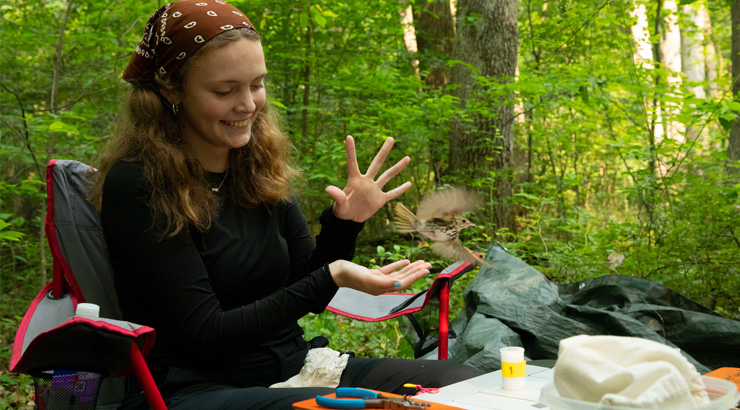
Learn in Nature
When you study ecology at Kutztown, you'll get hands-on experience in the field from the start.
Student Learning Outcomes
-
Biology (BS)
- Students completing the B.S. Biology degree will demonstrate advanced competence in their area of specialization, either organismal biology/ecology, cell biology/microbiology, pre-medical science, or allied health science.
- Students will demonstrate proficiency in skills useful in gaining successful employment in biology-related positions or admission to graduate or professional programs.
- Students completing the BS Biology degree will demonstrate writing skills such that they can effectively convey concepts and information in their discipline.
- Students completing the BS Biology degree will demonstrate oral communication skills such that they can effectively convey concepts and information in their discipline.
- Students completing the BS Biology degree will be able to effectively utilize the scientific method.
Organismal and Ecology Degree Frequently Asked Questions
-
What can I do with a Biology: Organismal Biology and Ecology degree?
Students who study ecology pursue careers in conservation, research, wildlife management, and environmental education. The following are job titles our graduates have pursued and their average annual salaries according to the U.S. Bureau of Labor Statistics (2025):
- Conservation Biologist: $73,920
- Environmental Consultant: $82,220
- Environmental Engineer: $107,110
- Landscape Architect: $79,870
- Field Ecologist: $70,732
- Game Warden: $68,180
- Park Ranger: $43,680
- Wildlife Biologist: $76,780
-
What graduate schools can I attend with my Biology: Organismal Biology and Ecology degree?
While you can start a career by studying ecology as an undergraduate, many students choose to attend graduate school. The following is a list of graduate schools our Biology: Organismal Biology and Ecology degree students have attended:
Graduate Programs:
Drexel University
Northern Arizona University
Oregon State University
Penn State University
Southern Illinois University
University of Arkansas -
Are internships required for the Biology: Organismal Biology and Ecology degree?
No, when you study ecology at Kutztown University an internship is not required. However, you can still complete internships for course credit, and they are highly encouraged. Our biology advisors are available to support students with internship placement and connect them to local organizations.
-
What career experience will I get as an environmental biology or ecology major?
As a major studying ecology and our environment at Kutztown University, you are guaranteed hands-on career experience in the field. You’ll have the opportunity to work in our outdoor classroom spaces at the Ronald R. Rhein Environmental Study Area and the Regenerative Organic Agriculture Living Lab.
For more controlled and smaller laboratory experiments, you can utilize the Nancy Jean Stump Seiger Botanical Research Center.