






Computer Science & Information Technology Highlights
Demo Day
Demo Day is the culmination of the analysis, design, code, integration and test of students’ capstone projects. The students have created solutions for: web applications, mobile application, video games, and information technology tools. Examples of previous projects include a game to learn about health issues, a smart system to monitor a room’s environment, a project to learn more about shaken baby syndrome, a network security tool, and a real-time collaborative coding platform. The presentations addressed the project on three levels: the application; software engineering theory; and project and team tools. The presentations are directed to a client audience, while the posters are directed to a technical audience.
Demo Day 2026
A student shows off their Capstone project
Demo Day 2026
Showing off Capstones with a smile!
Demo Day 2026
Students show off their Capstone project
Demo Day 2026
A student shows off their Capstone project
Demo Day 2026
Kutztown Foundation member asks a Capstone group questions about their project
Demo Day 2026
A student shows another student how to use their prototype program
Girls in STEM
The CSIT Department at Kutztown University organizes two Girls in STEM events designed to inspire and empower young students. These programs encourage participants to build confidence, expand their knowledge, and envision themselves as future leaders in STEM fields. The Girls in STEM Symposium, geared toward high school students, offers opportunities to connect with STEM professionals from local industries, providing valuable insight into a range of career pathways. The Jr. Girls in STEM event, created for students in grades 5–8, features interactive rotations through hands-on stations hosted by Kutztown University’s STEM departments, showcasing engaging demonstrations and activities.
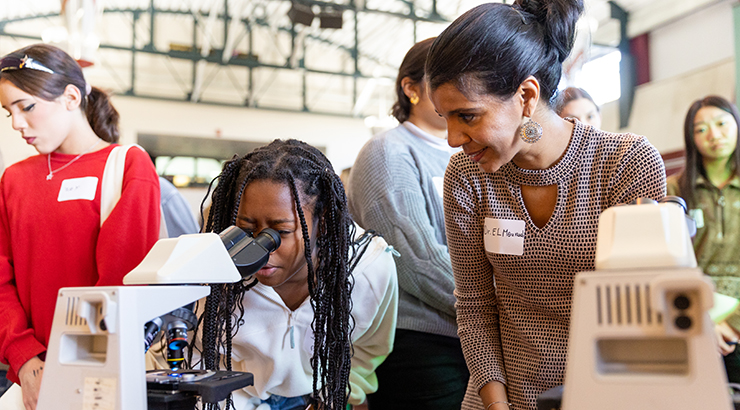
2023 Girls in STEM Symposium
Attendees at the Girls in STEM Symposium
Tech Guide's "Ask an Expert with Lisa Frye" about a Bachelor's in Computer Science
Master Student's Thesis Projects
|
Artificial Intelligence use as Academic and Emotional Support Among College Students, 2026; Student: Eve Collier with Faculty: Dr. Dylan Schwesinger and Prof. Donna DeMarco This research project explored how college students utilized Artificial Intelligence in academic and emotional support. Eve surveyed KU students asking questions about their use and thoughts about AI. She analyzed the data and presented results. |
Student Research Projects
|
Environmental Sensing with Wireless Sensor Networks, Summer 2017; Student: Nina Schynder with Faculty: Dr. Lisa Frye Project Description: This research project is to utilize Wireless Sensor Networks to perform environmental sensing. The Wireless Sensor Network(s) will consist of a variety of sensors that will collect data about the environment. It is the goal of this research to examine changes in avian populations as well as the number of different species that could reside in the local Kutztown region. As temperature and moisture can affect food supply, suitable habitat, and comfort levels, understanding how the climate affects bird species are integral to this study. |
|
The KU Game, Summer 2018 and Summer 2017; Student: Braden Luancing with Faculty: Thiep Pham Project Description: The grant provided an opportunity to research, design and development a 3D virtual interactive tour of Kutztown University. The game simulates how prospective students and their family can explore the campus and interactively engage with non-player characters (computer AI) to learn more about Kutztown University. |
|
Long Term Map Maintenance for Mobile Robots, Summer 2019; Student: Matthew Bartlett with Faculty: Dr. Dylan Schwesinger Project Description: Mobile robot applications use a representation of the real-world environment, a map, for navigation tasks. The map is typically created under the assumption that it will not need to change for future navigation tasks. The goal of this project is to find a map representation that can be updated during navigation tasks where the environment has features that are expected to change over time. |
|
Accelerating Complex Graphical Shapes, Sabrina Vagasky The goal of this project was to use the acceleration techniques in the Processing/Java framework to accelerate videos in 3D virtual worlds. In this project, I built PShapes which is a data type for storing shapes and contains a group of methods to create primitive shapes. PShapes can be built with external files like scalable vector graphic (SVG) files or with geometry. " SVG-format vector images can be rendered at any size without loss of quality and can be easily localized by updating the text within them, without the need of a graphical editor to do so. With proper libraries, SVG files can even be localized on-the-fly,” unlike “classic bitmapped image formats such as JPEG or PNG” (SVG: Scalable Vector Graphics). The renderer renders the graphics to a display monitor or raster graphics file. An image without a PShape like a JPEG or images on the web are called a raster graphic which is made up of a grid of pixels also known as a bitmap. Within Processing, a raster graphic object such as a Processing PImage or a conventional display monitor stores picture elements (a.k.a. pixels) as tiny dots consisting of combinations of red, green, and blue values. The difference between raster graphics and vectors graphics can be told when the user zooms in on an image. If a user zooms in closely to a raster image they begin to see individual pixels. A vector graphic object such as a Processing PShape consists of mathematical descriptions of groups of shapes that render into pixels only when displayed on a raster monitor. If a user zooms in closely to a vector image they continue to see a sharp image because the graphical renderer converts the mathematical descriptions to pixels after the zoom. |
|
Eclipsing Binary Stars that Exhibit the O’Connell Effect, Nicholas Paolella In conjunction with Dr. Reed of the Physical Sciences Department, this student is completing analysis of light curves and other data from eclipsing binary star systems for an asymmetrical light feature known as the O'Connell Effect, adapting audio signal analysis techniques prototyped by Dr. Parson. This project may lead to a published paper in an astronomical journal. |