






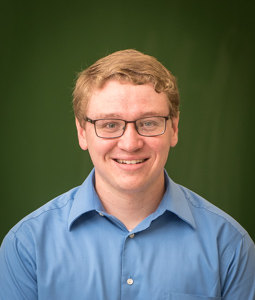
Alumni Story: Grant Fickes
Mathematician, United States Department of Defense
What are you currently doing?
I am a mathematician for the Department of Defense, where I work closely with interdisciplinary teams to solve complex, high-impact problems that support national security. My work relies heavily on mathematics and computer science, and I regularly apply concepts and problem-solving approaches I learned during my time at KU.
How did you get here?
I came to KU straight out of high school and quickly found my footing by building strong relationships with faculty mentors. Early on, I began working on a research project with Dr. Tony Wong, which introduced me to the long process of learning how to think and work like a mathematician.
That experience grew into multiple research opportunities, including the KU BEARS Summer Research Program and an REU at Lafayette College. Along the way, I presented my work at seminars and conferences locally and nationally, developing strong communication skills. These experiences led me to graduate school, where I further refined my skills before beginning my career.
How did KU prepare you?
KU provided an exceptional environment for growth through dedicated faculty, research opportunities, and academic rigor. I spent three years conducting undergraduate research, completed an Honors Thesis, and participated in competitions such as the Putnam Exam, Virginia Tech Regional Math Competition, and LVAIC team competitions. I also served as a Supplemental Instructor, minored in Computer Science, and remained active in music ensembles. These experiences — combined with mentorship from KU faculty — prepared me to think independently, communicate effectively, and persevere through challenging problems.
Advice for current students?
- Get involved early with research, clubs, competitions, and campus activities that matter.
- Build relationships with faculty mentors and learn from their guidance.
- Show up and persevere. Noticeable progress comes from consistent effort.
- Take advantage of every opportunity; even small steps can open big doors.
Trends to focus on?
- Develop strong foundations in mathematics and computer science.
- Focus on collaboration and communication in technical teams.
- Experience presenting technical work to varied audiences.
- Practice persistence and adaptability when tackling difficult problems.
Key Takeaway?
A KU math degree opens doors through mentorship, perseverance, and opportunity. Show up, work hard, and trust that consistent effort will lead to success.