





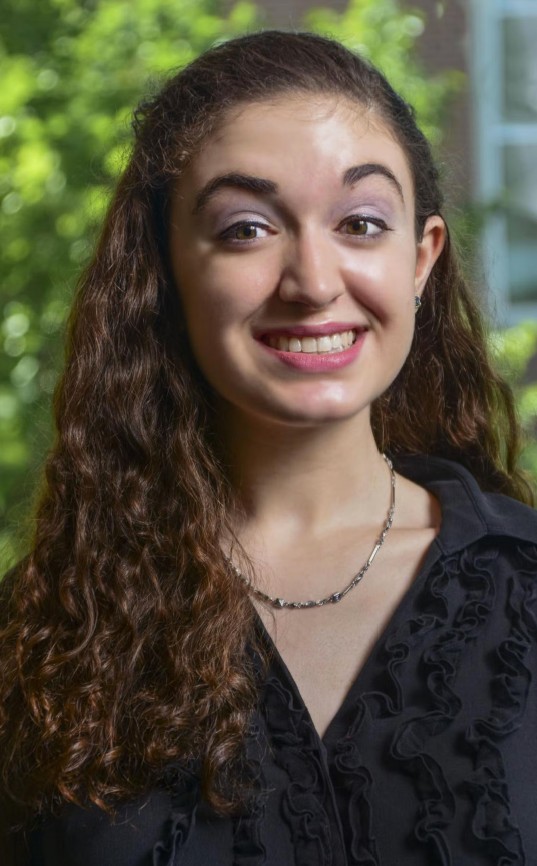
Alumni Story: Vanessa Maybruck
Ph.D. Candidate in Environmental Engineering at University of Colorado, Boulder; Certificates in Interdisciplinary Quantitative Biology and Data Science
what are you currently doing?
I am a Ph.D. candidate researching ways to reduce pharmaceutical pollution in wastewater and support water reuse. My work combines data science, statistics, and mathematical modeling with laboratory experiments. One project predicts pharmaceutical concentrations in treatment plants, while another studies how new gene therapy drugs (theraputic oligonucleotides) interact with wasterwater microbial communities.
How did you get here?
After graduating with a math degree from KU, I began a PhD in Applied Math at CU but switched into Environmental Engineering after discovering my passion through the Interdisciplinary Quantitative Biology Program. The flexibility to rotate between labs allowed me to find the right fit. I recently passed my comprehensive exam and will defend my PhD in 2026 or 2027 with the goal of becoming a professor.
How did KU prepare you?
The KU Math Department gave me a strong foundation in coding, modeling, research, and communication. My undergraduate research and internship at Oak Ridge National Laboratory (DOE SULI Program) were pivotal—leading to my first publication and strengthening my grad school applications. Leadership roles in Association for Women in Mathematics, Delta Alpha Pi, and the Honors Program also built my confidence and outreach skills.
Advice for current students?
- Try research and internships. Both are valuable for growth and career direction.
- Get involved in campus organizations to build leadership skills.
- Don’t stress if you don’t know your career path right away. It’s okay to explore.
- Follow your passions, even if they lead you to unexpected places.
Trends to focus on?
- Coding is essential: Learn Python and R, know Git/GitHub.
- Develop strong math, writing, and public speaking
- Environmental engineering requires an interdisciplinary background like chemistry, biology, physics, and policy.
- Gain lab experience if you’re curious about engineering research.
- Understand the potential and limitations of AI in research and society.
Key Takeaway?
A KU math degree provides skills that open doors across disciplines. Be curious, seek experiences, and invest in both technical and communication skills.