





Lakota Artist Delwin Fiddler to Present "The White Buffalo" for KU Family Series March 8
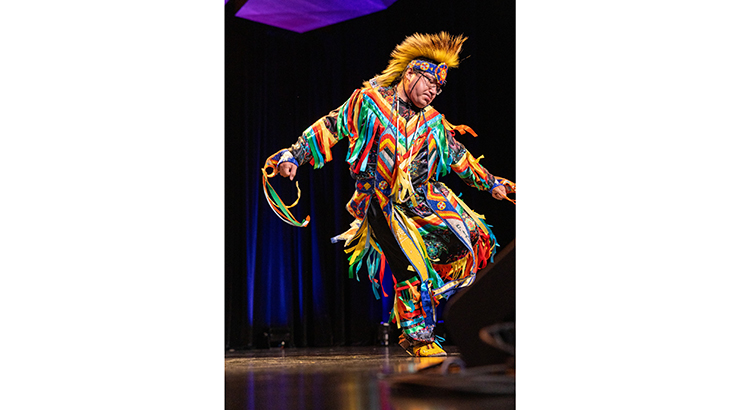
KUTZTOWN, Pa. – For the second of its three-show Family Series, KU Presents! will bring The PAZA Experience theatre piece "The White Buffalo" to Kutztown University's Schaeffer Auditorium 2 p.m. Sunday, March 8. The show will introduce people of all ages to the Lakota Sioux culture, combining storytelling, dance and music. It will feature Delwin Fiddler Jr. (Elk Bear) narrating, performing Hoop and Grass Dances and playing music; also featured will be Dr. Samora Free, a singer multi-instrumentalist and soundscape artist.
Tickets for “The White Buffalo” from Paza Experience are $20 for adults, $17 for seniors and $15 for KU students. Tickets can be purchased at the KU Presents website or by calling the KU Presents! Box Office 11 a.m. to 3 p.m., Tuesday through Thursday, at 610-683-4092. Established to be the center of cultural life at Kutztown University, KU Presents! serves the campus and community by bringing world-class live arts that entertain, educate and enrich.
Fiddler is the founder of PAZA, Tree of Life, a nonprofit group based in Easton, Pa. that is devoted to teaching and sharing many aspects of the Lakota tradition, with Native Americans and anyone else who would like to know more about this culture. Its logo explains it best: “Bringing People Together Through Culture, Community and Conservation.” Free is the manager of PAZA's Arts and Culture Department.
"The White Buffalo" tells the story of White Buffalo Calf Woman, who appeared to two Lakota men and brought the Seven Sacred Rites to the Lakota. Fiddler said, “We will sing and dance, and through that process, we will take the journey together. We want to bring all cultures together to walk the Red Road (the spiritual path). We have to hold on to the traditions and culture, the stories and the legacy, and we have to turn back to nature.”
During a recent Zoom interview, Fiddler exuded joy and excitement. He laughed often – a big, hearty, head-thrown-back laugh – and spoke of his lifelong search for truth and peace. His curiosity, fed by books and travel, allows him to talk about everything, from various arts (dance, music, film) to history, as well as Native American survival skills, practices and wisdom. He has an endless supply of ideas for future projects.
Born on the Cheyenne River Sioux Reservation in South Dakota, Fiddler said he was made aware from a young age that his grandfather was a designated Keeper of the White Buffalo Calf Pipe (smoked before all the Sacred Rites), and that he was expected to carry that responsibility forward. His family line included Crazy Horse and Sitting Bull, and his mother Shirley, whom he called “a historian by nature,” told him many stories about Lakota traditions and family history.
But on the isolated reservation, he said, “I didn’t have support as far as some general things a child needs. There were no good educational opportunities.” He needed to make a change, to feed his restless mind.
He traveled East, to Philadelphia, and quickly joined the Philadelphia Job Corps Center, which provided him with training and education. Soon he found his niche in Philly's creative community, where he became involved with the Native Nations Dance Theater. His skill at dancing and music took him all over the world, including performing at the White House and for the Royal Family in London. A video at the National Museum of the American Indian in Washington, D.C. shows a video Fiddler performing the Grass Dance every 15 minutes. He also began performing and lecturing about Lakota culture in universities and theaters.
After building his life in Philadelphia, Fiddler felt the need to return to his family on the reservation and share what he had learned, as well as to reconnect with his elderly parents. In 2011, at 30, he began a 13-year collaboration with documentary filmmakers Jonathan Olshefski and Elizabeth Day to create "Without Arrows." The documentary shows Fiddler's quest to dive deeply into his ancestral roots with his parents, brothers and extended family, as well as his daughter Kassi. The viewer is invited into Fiddler’s home, and into the family’s tragedies and joys, witnessing them building a sweat lodge, playing with their children, skinning a buffalo – the everyday business of living. The film premiered at the Big Sky Documentary Film Festival in February 2024, and since January 2025 has been available to watch on PBS as part of its Independent Lens series.
Since both of his parents have since passed away, Fiddler is settling into his life in Easton, where he has overseen the creation of the Medicine Wheel Garden in Hugh Moore Park, a collaboration between PAZA and the City of Easton. Dedicated three years ago, the garden contains symbolic elements, such as a Peace Pole, the Four Directions and a Red Road, as well as native plants.
While Fiddler acknowledges the difficulty of building trust between Native Americans and the descendants of those with whom they were often at war, he emphasizes the need “to spread peace and love and harmony. If you look at history, there are cycles. We're still here and we defend whoever is on this land."
“I want to express the White Buffalo, to bring good medicine to the people,” he said. “Now, a lot of Native people ask me, ‘How do the Natives survive?’ I say we always come in peace. We need to share and show people the cure for panic, anxiety, pressure, fear. It's a constant battle to be in the constant state of Now. To be aware of Nature, to follow the path. We need the old-time knowledge to survive."
Fiddler has found surprising connections between Pennsylvanians and the Lakotas and other Native people. He pointed out that there are bison in the Trexler Nature Preserve in Allentown, and a Lakota Foundation in that city. He also told of an Indian Steps Museum in York County with hundreds of arrowheads laid into its walls (to the surprise of this interviewer) and of the cemetery in Carlisle in which relatives of his who were forced to attend the Carlisle Indian Industrial School are buried.
“We all are made of the same stardust, as human beings,” he said. “I want to guide people to do what they want to do and push themselves to the limit and not be afraid. We need a space to be, to grow. Any of the creative arts are a big need for everyone. We aren’t promised a tomorrow, so we must make today the best we can, with stories, laughter, hugs. We are not alone."